Available now to order the new Regency Triple® featuring Corning® Enlighten™ Glass 

If you are weighing up bifold doors against patio doors, the core difference is simple. A bifold door folds back on itself in concertina sections to create a wide, open threshold. A patio door slides along a track and stacks behind a fixed panel. Both connect your home to the garden. How they do it, and how that feels in practice, is where the differences matter.
This guide covers the practical distinctions between the two so you can make the right choice for your home, your opening, and how you actually use the space.
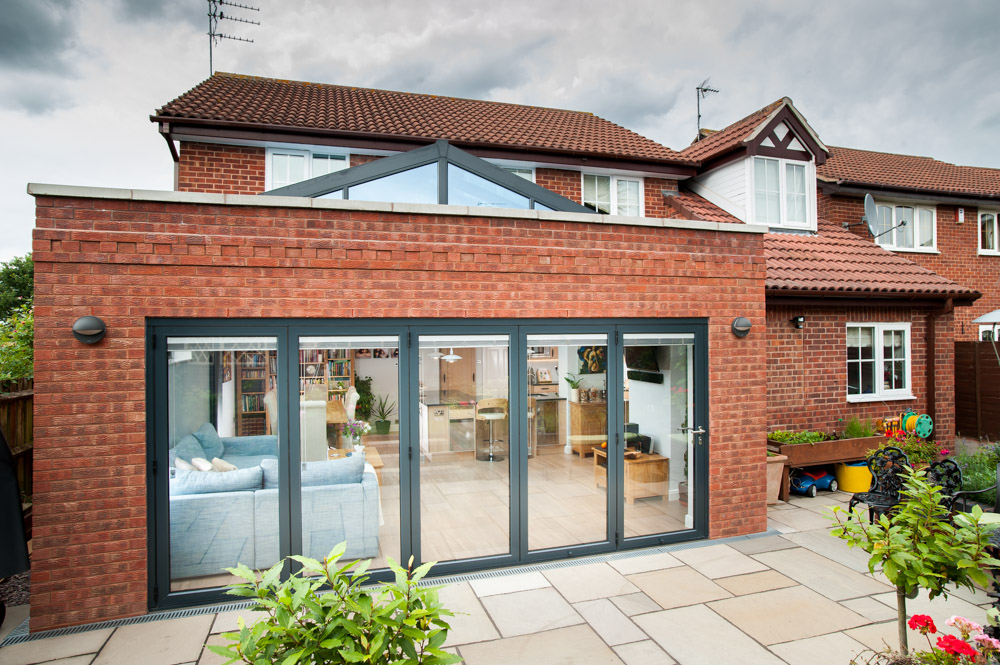
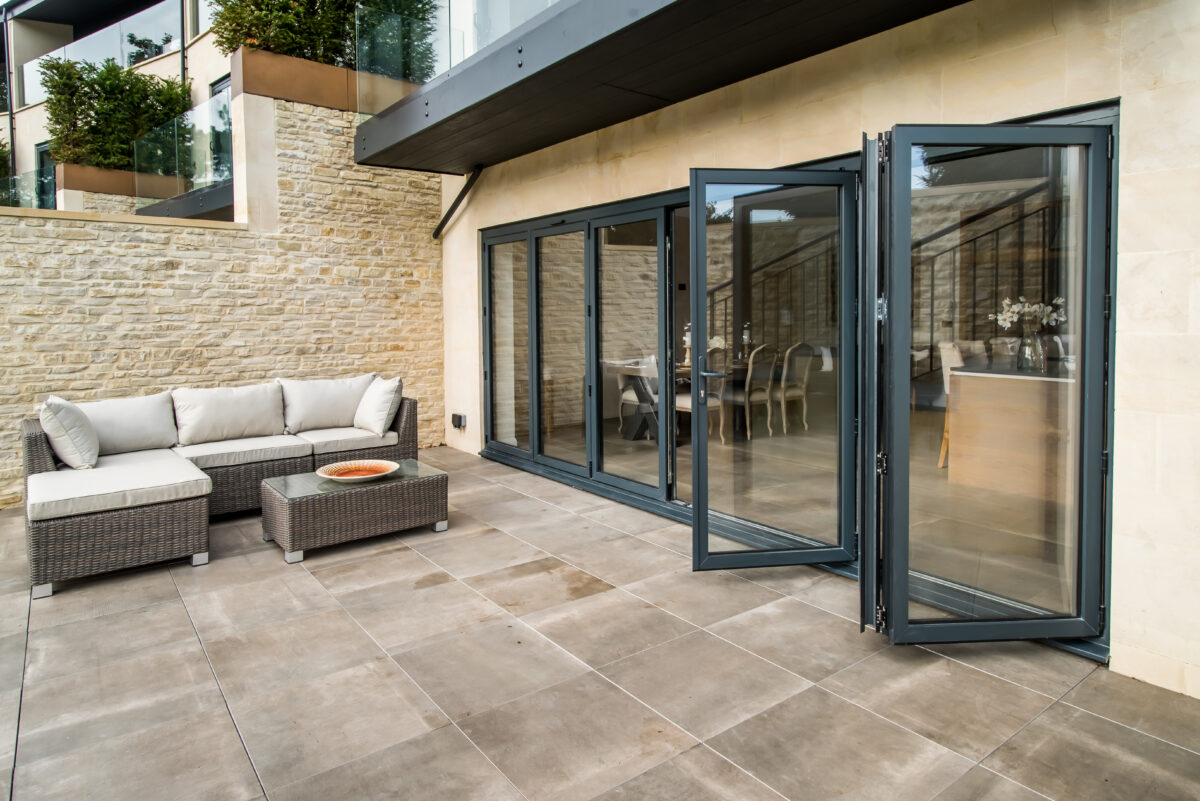
A bifold door set consists of multiple panels connected by hinges. When you open them, each panel folds against the next and the whole set stacks neatly to one or both sides of the opening. With the doors fully open, almost the entire width of the opening becomes clear space with no frame in the way.
The number of panels varies. Most residential bifold doors run from two to six panels, though larger configurations are possible. You can read more about the options in our post on how many panels a bifold door can have.
The folding mechanism means the doors need space to stack when open. A two panel set stacks neatly to one side. A six panel set creates a more substantial stack, which is worth accounting for in your room layout.
A patio door slides horizontally along a track. One or more panels move while at least one panel stays fixed. When the sliding panel reaches the end of its travel, it sits behind the fixed panel, leaving roughly half the opening clear.
Some patio door configurations allow more of the opening to become clear by stacking multiple sliding panels. However, patio doors rarely achieve the same fully open feel as a wide bifold set, because there is always at least one fixed panel in place.
The key practical advantage of a sliding patio door is that it needs no floor space to operate. Nothing swings or folds into the room or onto the patio. The door simply moves along its track without interrupting the space on either side.

This is where bifold doors have a clear advantage for wider openings. A six panel bifold door set across a four metre opening stacks away almost entirely, leaving close to the full four metres as usable threshold. A sliding patio door across the same opening leaves at least half of it as fixed glass.
If maximising the connection between inside and outside is the priority, bifold doors deliver more open space.
Patio doors win here. Because the panels slide rather than fold, they need no clearance on the floor inside or outside the property. Bifold doors need a small amount of floor clearance for the folding mechanism, and the stacked panels take up wall space on whichever side they fold to.
For tighter spaces, smaller rooms, or openings where the layout makes stacking panels awkward, a patio door is often the more practical choice.
Both door types use slim aluminium frames and large glass panels. From a purely visual standpoint, the differences are subtle when the doors are closed. The distinction becomes more apparent when the doors are open.
Bifold doors, when fully open, create a dramatic, uninterrupted connection between the two spaces. Many homeowners describe this as the reason they chose them. Patio doors, when open, create a cleaner, quieter transition. The opening is significant but the door itself becomes less of a feature.
From working with clients across Gloucestershire and beyond, we find homeowners who prioritise the visual impact of a fully open threshold tend to choose bifold doors. Those who want a door that disappears into the background and functions simply tend to lean toward patio doors.
Both bifold and sliding patio doors perform well in UK weather conditions when specified correctly. Both use thermally broken aluminium frames and high performance glazing to meet building regulation requirements.
Patio doors often have a slight edge in air and water tightness when closed, because the sliding mechanism creates a continuous seal along the track. Bifold doors have more panel-to-panel joints, which creates more potential points for air infiltration if the seals degrade over time.
In our experience, bifold doors perform better than older generations of sliding doors for weather resistance because the sealing technology in modern aluminium bifold systems has improved significantly over the past decade. However, for very exposed locations, a sliding patio door remains a strong option.
We cover weatherproofing in more detail in our post on how to weatherproof bifold doors and preparing your bifold doors for colder weather.
Both door types carry multi-point locking as standard across quality aluminium systems. Toughened safety glass is standard. Laminated glass is available as an upgrade on both.
For a detailed look at bifold door security specifically, our post on bifold door security and bifold door security at night cover what to look for in a well-specified system.
Both bifold and patio doors are available with low threshold options that create a near-flush finish between internal flooring and the external patio surface. This improves accessibility and creates a cleaner visual transition between inside and outside.
Our post on bifold door thresholds explains the options and what suits different floor setups.
Both door types need only basic maintenance to keep them performing well. Aluminium frames need no painting or treating. Periodic cleaning and an occasional check of the seals and hardware is sufficient for both.
Bifold doors have more moving parts than patio doors, which means there are more components to keep clean and aligned over time. Patio door tracks need regular cleaning to prevent debris build-up affecting the sliding mechanism.
Our post on bifold door maintenance covers the practical steps in detail.
Some openings suit one door type more naturally than the other. Here is what we see most consistently from our installations across Gloucestershire.
Bifold doors tend to work best when:
The opening is wide, typically three metres or more, and you want to maximise the clear threshold when the doors are open. The room layout allows for the folded stack on one or both sides. The homeowner wants the doors to make an architectural statement when fully open.
Patio doors tend to work best when:
The opening is narrower or the room layout makes stacking panels awkward. The homeowner wants a clean, low-profile door that slides without interrupting floor or wall space. The property is particularly exposed and continuous track sealing is a priority.
For some projects, the decision comes down to personal preference rather than practical constraints. Seeing both options in person makes the choice much easier. We have working examples of both bifold and patio door systems in our Cheltenham showroom. Visiting takes around an hour and removes most of the uncertainty from the decision.
French doors are a third option that sometimes comes up in this comparison. They open outward on hinges rather than folding or sliding, and they suit narrower openings where a two panel door covers the full width.
They cost less than bifold or patio doors in most cases, but they offer a smaller clear opening and are less suited to wider apertures. For a standard rear extension opening of three metres or more, bifold or patio doors are the stronger choice.
Our post on bifold door alternatives covers French doors and other options if you want to explore the full range before committing.

We have a separate post on bifold doors vs sliding doors which goes into greater technical depth on the sliding door mechanism specifically. If you have already decided on a sliding door and want to understand the details, that post is the better starting point. This guide focuses on the practical decision between bifold and patio doors as categories, covering the full picture for homeowners at the point of choosing between the two.
We supply and install both bifold doors and patio doors across Cheltenham, Cirencester, Stroud, Gloucester, Tewkesbury, Bristol, Bath, Worcester, Hereford, and across the wider region.
Every quote is free and bespoke to your opening size, chosen system, and specification. Use our online quote tool to get a figure, or visit the showroom to see both door types in person before you decide.
You can also read about why customers choose Bifold Shop and what our installation process involves on our bifold door installation process page.


