Available now to order the new Regency Triple® featuring Corning® Enlighten™ Glass 
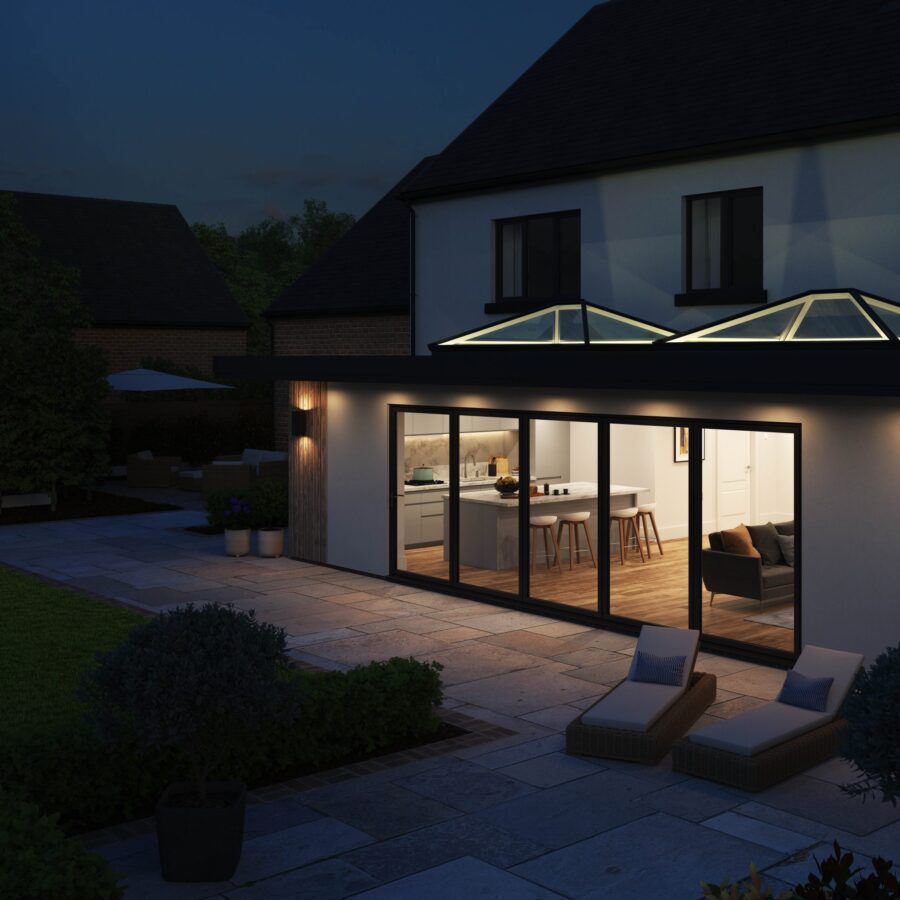
Yes, you can get bifold doors for small openings. A two panel set works comfortably from around 1.6 metres wide, and some systems go narrower still. Below roughly 1.5 metres, though, a bifold starts to make less sense than a French door or a single door, for reasons that are worth understanding before you spend the money.
This guide covers the genuine minimum size a bifold door works at, why very small openings are often better served by a different product, and how to decide where your own opening sits. The honest cut-off matters here, because a bifold squeezed into too small an opening gives you the cost and complexity of folding doors without the benefit that makes them worth it.
The limit is set by the panels, and specifically how narrow each one can be.
Origin panels run from 400mm to 1200mm wide. Smarts works to comparable limits. A single panel narrower than about 400mm becomes awkward to operate and starts to look wrong, so that lower figure is the practical floor for one leaf.
A two panel bifold therefore needs enough width for two sensible panels plus the frame. In practice this means a two panel set works well from around 1.6 metres, and can be pushed a little lower on some configurations. Below that, you are into two very narrow panels, and the result rarely justifies itself.
The number of panels a bifold can carry scales up from there, but for small openings the two panel set is almost always the relevant configuration.
It helps to understand what actually goes wrong when a bifold is forced into too small an opening.
A bifold door earns its place by folding right back and opening up most of the width. On a wide opening, that transformation is dramatic. On a very narrow one, there is little width to open up in the first place, so you pay for the folding mechanism and gain very little from it.
There is a physical issue too. Narrow panels still need the same hinges, carriages, and frame depth as wider ones. On a small opening, that hardware takes up a proportionally larger share of the width, which eats into the glass and thickens the sightlines relative to the opening. The doors end up looking heavier and busier than the space warrants.
We have found that customers set on a bifold for a small opening are often happier with the result once they see a two panel set working at a sensible width in the showroom, rather than pushing for folding doors on an opening that does not suit them.
There is one small-opening bifold worth knowing about: the single leaf configuration.
Some systems offer a single panel that hinges and opens like a door but sits within the bifold frame and hardware family. This suits narrow openings where you want the aesthetic and the flush threshold of a bifold system without room for a true folding set. It is a niche option, but it exists, and it can be the right answer on a tight opening that still needs to match adjacent bifold doors elsewhere on the property.
For openings below roughly 1.5 metres, a French door is very often the better product, and it is worth saying so plainly.
A French door gives two panels that open on hinges from a central meeting point. On a small opening, this delivers a clear, uninterrupted view when closed and a wide opening when both leaves are open, without the folding hardware a bifold carries. It usually costs less as well.
In our experience, a French door works better than a two panel bifold on openings under about 1.5 metres because you get a cleaner sightline, a lower cost, and an opening that suits the space rather than fighting it. The bifold only pulls ahead once the opening is wide enough for its folding action to genuinely transform the space.
Our bifold door alternatives guide covers French doors and other options in more detail, and the wider bifold versus sliding comparison is useful if you are weighing door types generally.
None of this means a bifold is wrong for every smaller opening. There are good reasons to choose one at the lower end of the range.
If you want the doors to fold completely clear of the opening, a bifold does that and a French door does not. A French door’s open leaves sit within or across the opening, whereas a bifold stacks its panels to the side and leaves the aperture clear. On a smaller opening where even a modest obstruction matters, that clear stack can be the deciding factor.
Consistency is another genuine reason. If you already have bifold doors elsewhere on the house and want a smaller matching set on an adjacent opening, staying within the same system keeps the sightlines, colour and hardware consistent across the elevation. That visual coherence is worth something.
And on a two panel set at a sensible width, a bifold gives you the flush low threshold and the slim aluminium look that a French door in the same material can match on threshold but not always on sightline.
Cheltenham and the surrounding area have plenty of older properties with smaller or irregular openings, and these bring their own considerations.
Period openings are frequently out of square, and a small opening shows misalignment more obviously than a large one, because there is less width to absorb it. Getting the survey right matters just as much on a small bifold as a large one. The particular challenges of fitting into an older house apply fully at the smaller end.
The structure above still needs to be sound, though a smaller opening usually means a simpler lintel situation than a wide one. Either way, we check it at survey before anything is ordered.
If a bifold is the right call for your small opening, a few choices make the difference.
Keep the panel count low. On a small opening, two panels is almost always right, and adding more just multiplies the sightlines across a narrow width. Choose the fold direction so the stacked panels sit where they least obstruct the space. Consider the colour carefully, because on a small set the frame is a larger part of what you see.
Both Origin and Smarts carry the same multi-point security on a two panel set as on a larger one, so a small bifold is no less secure. Our installations carry a 10 year installation guarantee backed by HomePro Insurance, with up to 20 years on Origin frames.
The easiest way to decide between a small bifold and a French door is to stand in front of a two panel bifold and see how it works at that width. Our showroom in Cheltenham lets you do exactly that, and we can talk through your specific opening against both options honestly.
We install across Cheltenham, Stroud, Cirencester, Gloucester, Tewkesbury and Bristol, with nationwide supply available. You can see what customers say on Trustpilot, and there is more on the installation process if you want to know what fitting involves.
Every quote is free and bespoke to your opening, however small. Get in touch to arrange a survey.


