Available now to order the new Regency Triple® featuring Corning® Enlighten™ Glass 
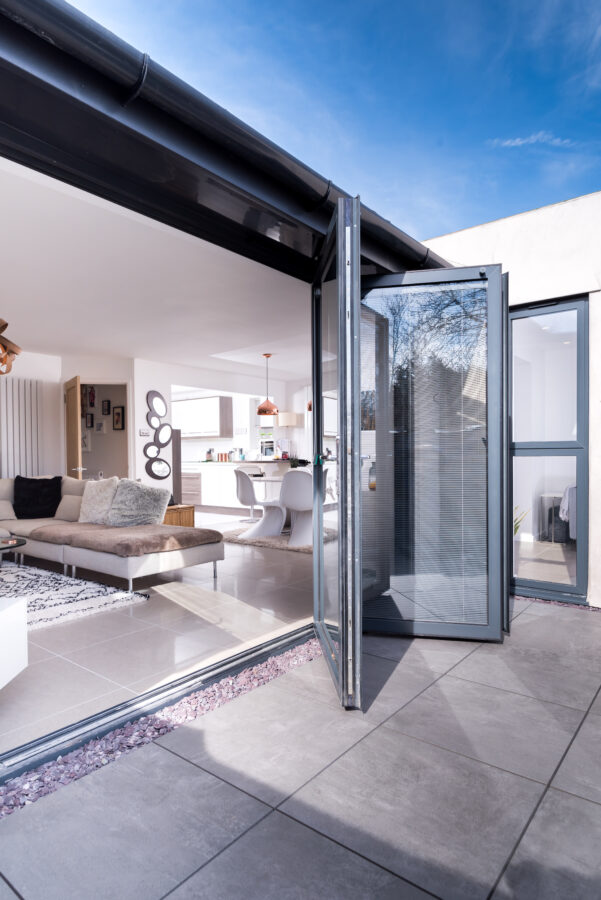
Modern aluminium bifold doors, when correctly specified and installed, do not let in draughts. This is one of the most common concerns people raise before buying, and it is largely based on the reputation of older or poorly made systems that gave bifold doors a bad name a decade or more ago.
The short answer is that a well-made bifold door from a quality manufacturer, fitted by an experienced installer, performs as well as any other external door product in terms of weather resistance. This guide explains why, and what to watch out for if you are comparing products or dealing with an existing draught problem.
The concern about draughts is not without origin. Early bifold door systems, particularly lower-cost uPVC products from the late 2000s and early 2010s, did have genuine issues with air and water infiltration. The seals between panels degraded quickly, the frames were not always thermally broken, and the hardware tolerances were looser than they needed to be.
Those products gave bifold doors a reputation that modern aluminium systems simply do not deserve. The engineering has moved on considerably, and the performance gap between a quality bifold door today and a quality fixed window is much smaller than most people expect.
We have been installing bifold doors across Gloucestershire for over twenty years. In that time, the complaints we hear about draughts almost always relate to one of three things: an older system that has degraded over time, a cheaper product that was never well-sealed to begin with, or an installation that was not carried out properly regardless of the product quality.
Understanding how a bifold door seals helps explain why modern systems perform as well as they do.
Each panel in a bifold door set has a compression seal along its edges. When the doors close, these seals compress against each other and against the frame, creating a continuous barrier against air movement. On quality systems, these seals maintain their compression across years of regular use.
The number of panels affects how many seal-to-seal joints the set contains. A two panel door has fewer joints than a six panel door. More joints means more potential points for air infiltration if the seals degrade or the panels fall out of alignment. This is one reason why good installation and periodic maintenance matter more on larger bifold sets.
The top rail of a bifold door seals against the head of the frame. The bottom of each panel seals against the threshold. On low threshold installations, the seal between the panel and the floor-level threshold is particularly important because the gap is deliberately minimal to achieve the flush finish most customers want.
Both Origin and Smarts bifold door systems use multi-point bottom seals across their ranges. These create a reliable barrier at the base of the door where cold air is most likely to enter at ground level.
A thermally broken aluminium frame does not just improve thermal efficiency. It also contributes to weather resistance by maintaining the structural integrity of the frame across a wider temperature range. Frames that expand and contract significantly with temperature changes put stress on seals and can cause gaps to develop over time. A thermal break reduces this movement and helps the seals stay effective for longer.
Our post on how to fix draughty bifold doors covers what to check if you already have a draught problem and what the likely causes are.
Even on a well-made system, draughts can develop over time if certain conditions occur. These are the most common causes we see.
Compression seals do wear over time, particularly on doors used frequently. A seal that has lost its compression no longer creates a tight barrier when the doors close. This is usually a straightforward fix, and replacement seals are available for most quality systems.
Our post on bifold door maintenance covers how to inspect and maintain seals as part of a regular maintenance routine. We also cover this in our guide on preparing your bifold doors for colder weather, which is worth reading before winter sets in.
Bifold door panels that fall out of alignment do not close squarely, which means the seals do not compress evenly. This can happen gradually over time as the doors settle, or more quickly if the installation was not carried out on a level, square opening.
Most quality bifold door systems include adjustable hinges and carriages that allow the panels to be realigned without major work. If you notice a draught developing on a relatively new installation, misalignment is often the first thing to check.
Our post on troubleshooting common issues with bifold doors covers alignment issues and how to address them.
The quality of the installation matters as much as the quality of the door. A bifold door fitted into an opening that is not square, level, or properly prepared will never seal as well as the same door fitted correctly. This is particularly relevant on older properties where the opening may have moved or settled over time.
We carry out a full site survey on every installation before the doors are ordered. We check the opening dimensions, assess the floor levels and threshold conditions, and identify any structural issues that could affect how the doors sit and seal. Identifying these before the order is placed is far better than discovering them on the day of fitting.
Our post on how to install bifold doors in an old house covers the specific challenges older properties present and how we approach them.
A bifold door from a manufacturer who cuts costs on seals, hardware tolerances, or frame engineering will not perform as well as a quality system, regardless of how well it is installed. This is the area where the market varies most significantly.
We supply bifold doors from Origin and Smarts. Both manufacturers engineer their systems to tight tolerances and use seals designed to last the lifetime of the product under normal residential use. Neither is the cheapest option on the market, and that is intentional. A draught problem caused by an inferior seal on a budget system is not something better installation can fully compensate for.
Our post on five things to consider when choosing a bifold door covers what to look for in a quality system before you commit to a purchase.
Sliding patio doors tend to have a slight advantage over bifold doors in terms of continuous seal performance when closed. A sliding door creates a single continuous seal along its track length, whereas a bifold door has multiple panel-to-panel joints. In practice, both perform well in normal residential conditions when properly specified and installed.
In our experience, bifold doors perform better than older sliding door systems for overall weather resistance because the sealing technology in modern aluminium bifold systems has improved more significantly in recent years than equivalent sliding door technology. However, for very exposed coastal or upland locations, a sliding patio door remains a strong alternative worth considering.
Our post on bifold doors vs sliding doors covers the comparison in more detail. We also have a dedicated guide on how to stop bifold doors blowing in the wind for customers in more exposed locations.
If draught resistance is a priority for your project, here is what to focus on when comparing systems.
Multi-point locking pulls the panels tightly against the frame at multiple points when locked, compressing the seals fully. This is standard on quality systems but absent on cheaper ones.
Compression seals rather than brush seals at the panel-to-panel joints. Compression seals create a tighter barrier and degrade more slowly under regular use.
Thermally broken frames reduce expansion and contraction across temperature ranges, which helps seals stay effective for longer.
Adjustable hardware allows the doors to be realigned as they settle over time, maintaining the seal quality years after installation.
An experienced installer who surveys the opening properly before ordering, fits on a level and square threshold, and checks the seal compression before signing off the job.
For more on what separates quality bifold door systems from cheaper alternatives, our post on aluminium bifold doors vs uPVC bifold doors and our guide on bifold door materials both cover the relevant specification details.
One specific concern people raise is whether bifold doors feel cold in winter, even if they do not technically let in a draught. This is a separate issue from air infiltration and comes down to the thermal performance of the frame and glazing rather than the seals.
A poorly insulated frame conducts cold from outside to inside through the aluminium itself. This creates a cold surface inside the room even when the doors are fully closed and sealed. A thermally broken frame with high performance double glazing eliminates this effect in normal residential conditions.
Our post on how energy efficient are bifold doors covers thermal performance in detail. Our guide on bifold doors energy efficiency tips and benefits is also worth reading if you are specifying bifold doors for a room you want to use year-round.
Modern aluminium bifold doors do not let in draughts when they are correctly specified and installed. Draught problems occur on older systems, cheaper products, or installations that were not carried out properly. Choosing a quality manufacturer, a thermally broken frame, compression seals, and an experienced installer removes the vast majority of the risk.
If you are based in Cheltenham, Stroud, Cirencester, Gloucester, Tewkesbury, Worcester, Bristol, Bath, Hereford, or anywhere else across the region, you are welcome to visit our showroom in Cheltenham. You can operate the doors yourself, check the seals, and ask our team exactly how each system performs before you commit to anything. Every quote is free and bespoke. Use our online quote tool or get in touch directly to discuss your project.


